Anyone who has either bought or considered buying an electric car will be familiar with the term “range anxiety.” The simplest explanation for the term is that EV drivers can stress about their car’s remaining range because public charging infrastructure is often thought of as patchy and unreliable. If drivers can’t charge their car, they’ll have no way to get home.
There’s certainly still plenty of room for improvement across America’s charging infrastructure. However, a new study by JD Power suggests that there are now fewer reasons to be anxious about range than before. Satisfaction rates vary between different networks, but overall, survey respondents reported the lowest rate of visits where they couldn’t charge since the study began. Satisfaction with charging costs and safety at charging locations also improved.
When it comes to overall satisfaction, Tesla’s Supercharger network continues to score above the segment average for national DC fast charging networks, but it didn’t earn the top spot. Instead, that honor went to Ionna, a network that’s backed by a group of automakers, including GM, Honda, and Stellantis. Ionna offers chargers that can deliver up to 400 kW, and unlike some rivals, it does not require a dedicated app or subscription to use. Its locations also usually feature additional services to complement its chargers, like food and drink outlets and restrooms.
Automaker-backed networks led the satisfaction rankings
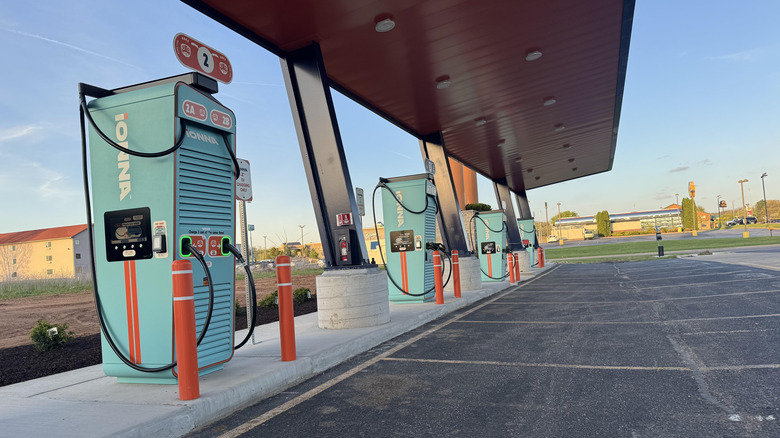
Alongside GM, Honda, and Stellantis, five other automakers co-founded the Ionna network. They are BMW, Hyundai, Kia, Toyota, and Mercedes-Benz. Mercedes-Benz has its own charging network, which was ranked the second most satisfactory network in the latest JD Power survey. Taking third place was another OEM-backed network, Rivian Adventure Network. Tesla’s Supercharger network ranked fourth.
Not every DC fast-charging network was as highly rated by respondents. At the bottom of the table was ChargePoint, with EVgo receiving the second-lowest score. Level 2 networks also saw a decline in user satisfaction in the survey, with respondents citing increased difficulties getting their vehicles to charge and issues with payment.
Even though some charging networks are still subject to plenty of complaints, the general trend is a positive one. That could make all the difference to EV sales, according to Brent Gruber, executive director of EV solutions at JD Power. He said that “JD Power data consistently shows that public charging is the top reason new-vehicle shoppers reject EVs,” adding that the recent improvements are “help[ing] build customer confidence that they can pull in, start a charge and get back on the road quickly.”