For the longest time, Lexus — and parent company Toyota — have rode in business class aboard the hybrid train. For the luxury brand, that began with the 2005 RX 400h, and continues today with examples like the UX Hybrid, the LX 700h, and the ES Hybrid. But as far as EVs were concerned? Only in 2019 with the Eastern Hemisphere-only UX 300e did Lexus dip its toes into the tingly electron waters, long after the likes of Mercedes-Benz, BMW, Genesis, Audi, and Cadillac all painted themselves in cobalt blue.
The automaker has only slowly made progress since then, with the introductions of the RZ for the 2023 model year, and the ES Electric for the 2026 model year. The RZ in particular has the distinction of being the first Lexus EV to be sold worldwide, based upon the same e-TGNA platform as the Toyota bZ and their distant cousin, the Subaru Solterra.
Has this decision to stay hybrid-focused hurt their EVs, though? To determine this and more, Lexus sent my way a 2026 RZ in its hottest form, the RZ 550e F Sport AWD, dressed in an aptly named shade of gray called “Wind.” And while I would, indeed, be gliding along the streets and interstates woven through my small town in the New River Valley of Southwestern Virginia, would I be going with the flow, or face headwinds of my own? We certainly had thoughts back when we first reviewed the RZ in 2023. Let’s see if anything’s changed four model years’ later.
Six ways to an expensive Sunday
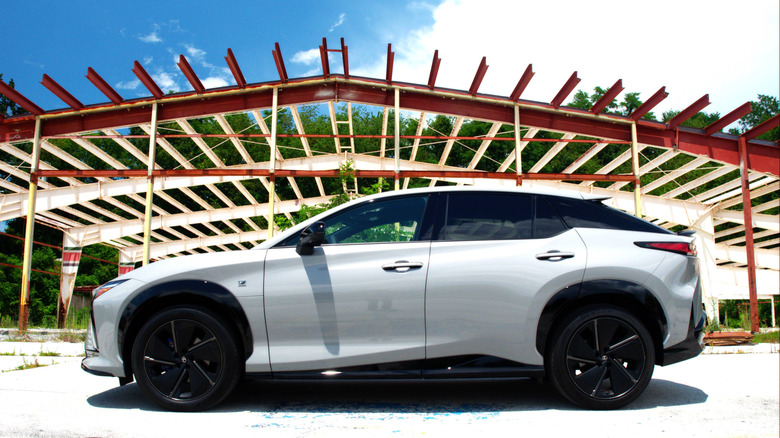
When the Lexus RZ debuted for the 2023 model year, two trims were available: the 450e Premium and the 450e Luxury. Four model years later, a total of six trims make up the RZ catalog. Here’s what you can expect to pay for your 2026 Lexus RZ of choice before options and the $1,295 destination charge:
- RZ 350e: $46,100
- RZ 350e Premium: $48,300
- RZ 450e AWD: $49,600
- RZ 450e Premium AWD: $51,800
- RZ 450e Luxury AWD: $57,100
- RZ 550e F Sport AWD: $57,100, $62,034 total sticker as-tested
Competition in the RZ’s luxury electric SUV class is fairly fierce, especially when it comes to range. Already on the market are the Genesis GV60 ($52,525 – $71,875) and the Cadillac Optiq ($50,900 – $67,300), whose “fuel tanks” are good for a weekend outing and the everyday, paired with exceptional interiors and tech features. Fast approaching is the hotly-anticipated Rivian R2 ($53,990 – $57,990).
Where’d the frunk go?
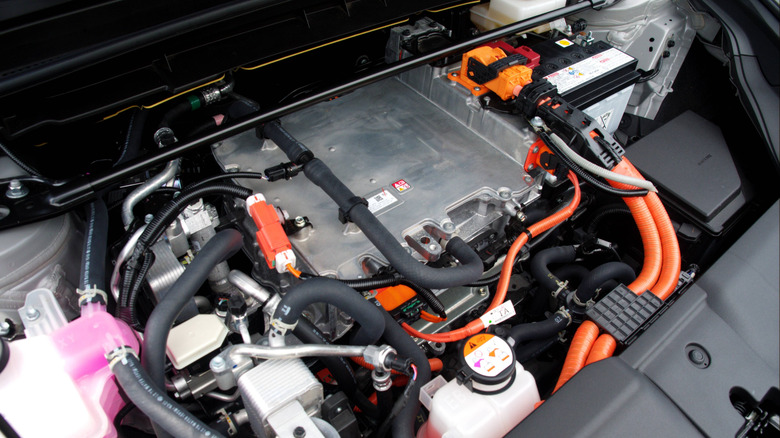
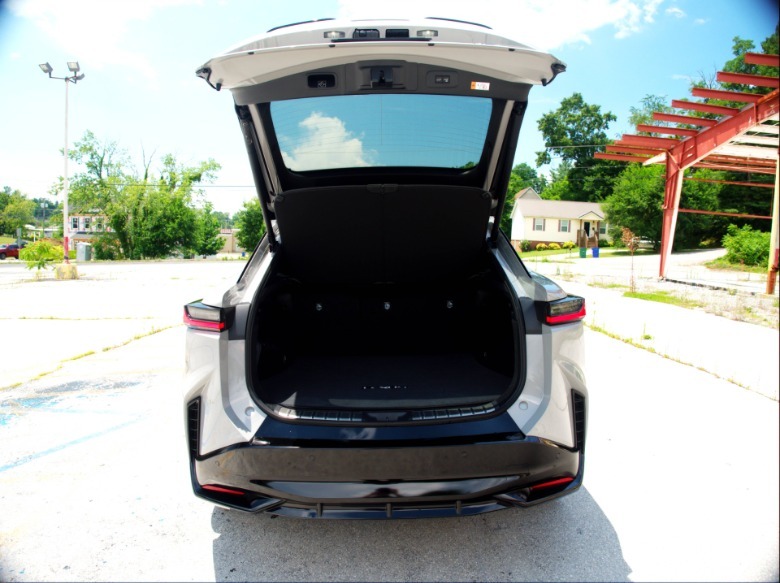
Typically on EVs, you pop open the hood to reveal a smaller storage space where the engine would be in gas, diesel, and hybrid machines. In some cases — like the recently deceased Ford F-150 Lightning or still-living Chevrolet Silverado EV — that space is substantial enough to truly be, as the kids say, a frunk.
Not so on the 2026 Lexus RZ. There is simply nowhere up front to store even the portable charger, never mind small bags or some outdoor gear. Instead, you find the electric powertrain in all of its naked, orange-cabled glory.
 Cameron Aubernon/SlashGear
The RZ 350e and 350e Premium feature a single motor delivering 221 horsepower and 198 lb-ft of torque to the front wheels alone. The 450e Premium and 450e Luxury, plus the base 450e, all use a dual-motor setup for electric all-wheel drive with 308 horsepower and 321 lb-ft of torque. Both the 350e and 450e trims get their electrons from a 74.7-kWh lithium-ion pack, too.
The new-for-2026 550e F Sport AWD receives a larger 77 kWh pack to go with its pair of electric motors, good for 402 horsepower and 396 lb-ft of torque. All powertrains earned quite substantial MPGe ratings from the EPA, but that comes with a caveat, as I’ll explain later on.
Still waiting on that yoke, Lexus
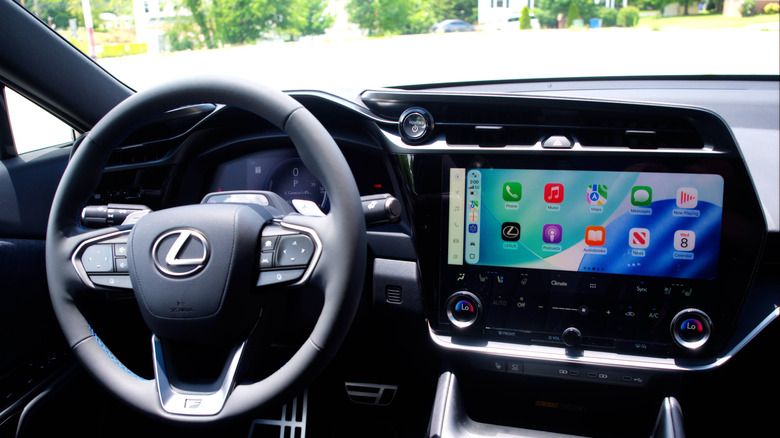
Back in 2023, Lexus was talking up the RZ’s clever yoke steer-by-wire system. That’s still to arrive in the U.S., so for now the 2026 RZ must stick with the classics. And that includes an old Lexus classic: the touchpads on the steering wheel. You get two of them, one per side, to control your cruise control and audio settings by default, though you can map them to do other things, too, such as your drive modes. I’ve gotten used to this bit of derided tech by now, but I still prefer physical controls for such things.
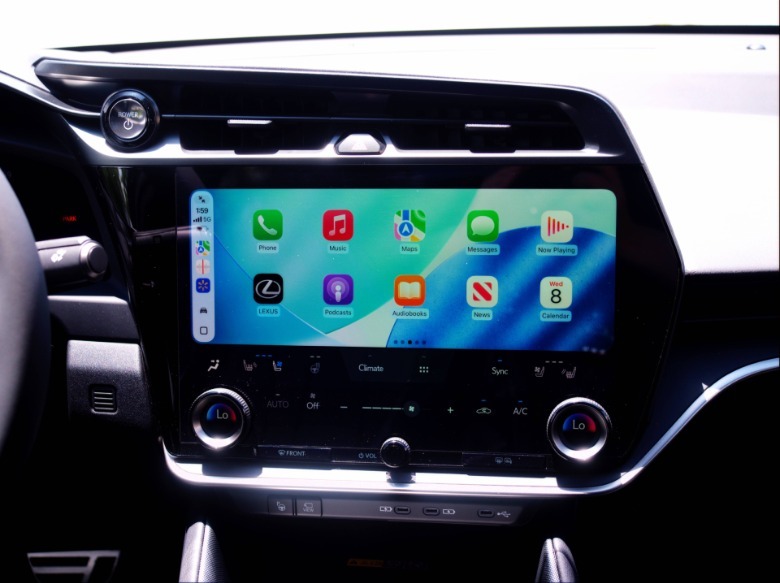 Cameron Aubernon/SlashGear
Every trim features a big 14-inch touchscreen equipped with wireless Apple CarPlay and Android Auto, satellite radio, a base 10-speaker stereo or an available 1800-watt 13-speaker Mark Levinson system, wireless device charging, five USB ports, “Hey Lexus” voice control, and the usual assortment of subscription services Lexus offers its customers.
There’s quite a list of standard safety features, beginning with the Lexus Safety System 3.0+ suite, which include pre-collision, dynamic radar adaptive cruise control, lane assist, road sign assist, and proactive driving assist. On top of that there’s blind-spot monitoring, automatic high beams, rear cross-traffic alert, a rearview camera, vehicle exit warning, and rain-sensing wipers among the list. Available features include a head-up display, surround-view camera system, a rear-camera mirror for when heads and bags get in the way of a safe view of the traffic behind you, hands-free parking, and traffic-jam assist.
The RZ’s cabin is a nice place to be
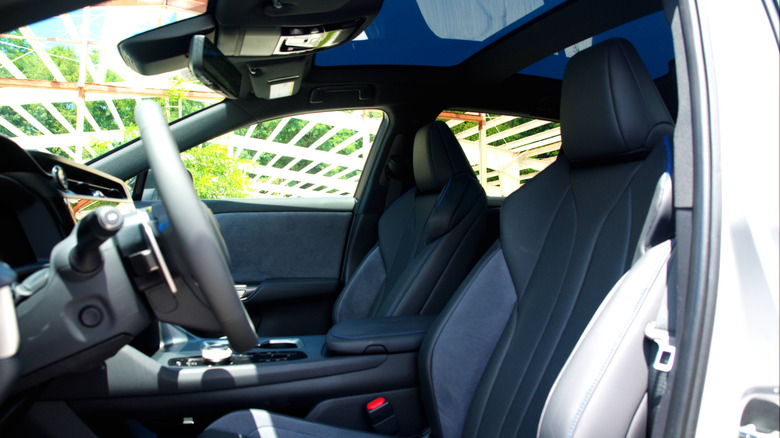
There are plenty of ways to experience the interior of the RZ, from the base level all the way to the muscular 550e F Sport. Out the gate, there’s synthetic leather seating for five, a heated steering wheel with power tilt-and-telescoping adjustment, dual-zone climate control, 10-way power-adjustable driver’s seat, 8-way power-adjustable front passenger seat, and heated and ventilated front seats.
From there, options like a cold-weather package (headlamp washers and windshield wiper de-icer), hands-free power liftgate, an electrochromic panoramic sunroof that goes from opaque blue to clear blue at the push of a button, synthetic suede upholstery, heated rear seating, and acoustically insulated windshield and side glass can be added, depending on trim and packages chosen.
 Cameron Aubernon/SlashGear
As far as carrying people and bags go, it’s not too bad either. Front occupants receive 42.1 inches of legroom while the three passengers on the rear 60/40-split bench get 37.5 inches to stretch out. Headroom’s quite good, too, with 350e trims delivering 38.6 and 38.7 inches for front and rear, respectively, with all others provide 39.9 inches up front and 39.7 inches in the back.
Trim makes a difference on what’s behind the rear seatbacks, too. The 350e models offer 34.1 cubic feet of space, while the 450e and 550e kick it up ever so slightly, to 34.9 cubes. Lexus is coy on how much room there is with the second row folded down, but for what it’s worth, the Toyota bZ offers 56.9 cubic feet, and the Subaru Solterra brings 63.9 cubic feet to the table. The RZ likely hovers between its two relatives.
A fine ride with some quirks
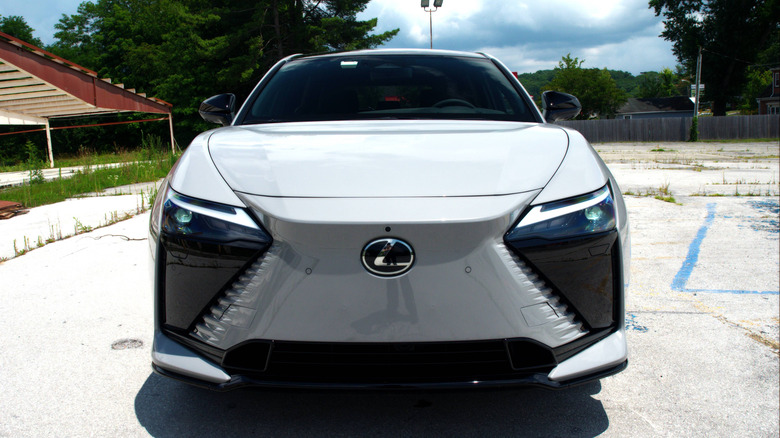
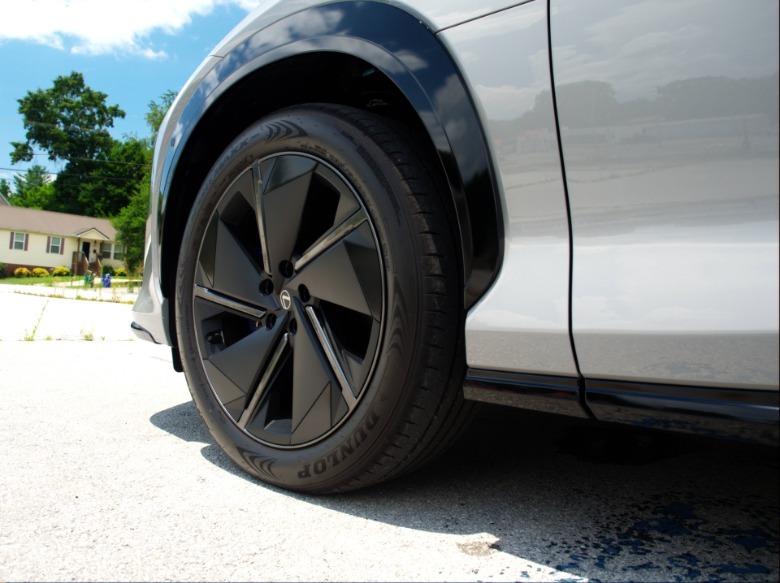
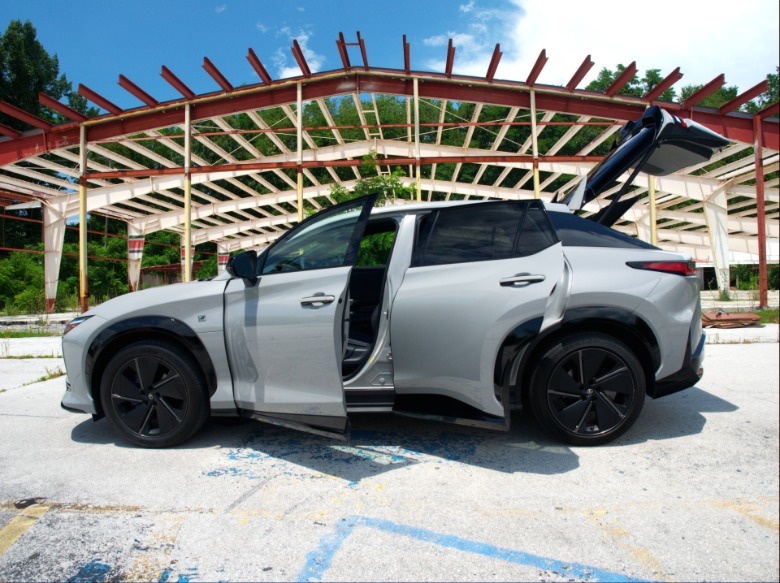
We’ll get the good things out of the way first. The RZ’s MPGe rating ranges from good to great, with the 350e on the great end at a combined 126 MPGe (136 city/115 highway) due to having only a single motor and 18-inch wheels. My 550e F Sport AWD is on the other end of the scale due to its larger 20-inch wheels and more performance-oriented capability, dropping to a combined 95 MPGe (102 city/88 highway) on paper. In reality, I managed a final total of 3.2 miles per kWh, which translates to 108 MPGe. Not bad at all!
 Cameron Aubernon/SlashGear
As befitting a performance-focused EV, my RZ had no trouble getting up to highway speeds; it can hit 60 mph from a stop in 4.1 seconds, while the 350e takes a leisurely 7.1 seconds to do the same. Handling was fine, too, especially while winding down through the switchbacks into Pulaski on my standard 60-mile loop through Southwestern Virginia. Inside, everything was quiet and comfortable, though not everyone will be a fan of the snug front bucket seats.
And remember when I said you could add functions to the trackpads? I decided to add all of the drive modes on the same side as the cruise control trackpad. Yet, when I went to engage a different mode for the interstate portion of my loop, the RZ told me I had to turn off cruise control first before it could switch modes. That’s annoying, to say the least. But not nearly as annoying as the elephant in the room.
The electric elephant in the room
We always worry about losing range when things get chilly, but the same can be said for when things get really hot. Parked outside, the RZ experienced significant fluctuations in range depending on how hot the temp was during the day. When it first arrived in the late afternoon, I had only 189 miles to work with. The first morning, though, that range jumped to around 194 miles, a pattern that would persist throughout the week due to cooler mornings and hotter afternoons (mid-60s vs high 80s plus sun exposure heating up everything).
 Cameron Aubernon/SlashGear
There’s also the range issue: just 229 miles per charge for the 550e F Sport, even with its bigger battery; the base 350e has the highest range at 301 miles. You could chalk it up to being more performance oriented with larger wheels, but when there are others in its class that do better, from the Cadillac Optiq (278 to 317 miles) to the upcoming Rivian R2 (275 to 345 miles). After focusing on hybrids for so long, it just seems like Lexus and Toyota still have a ways to go on this whole EV thing.
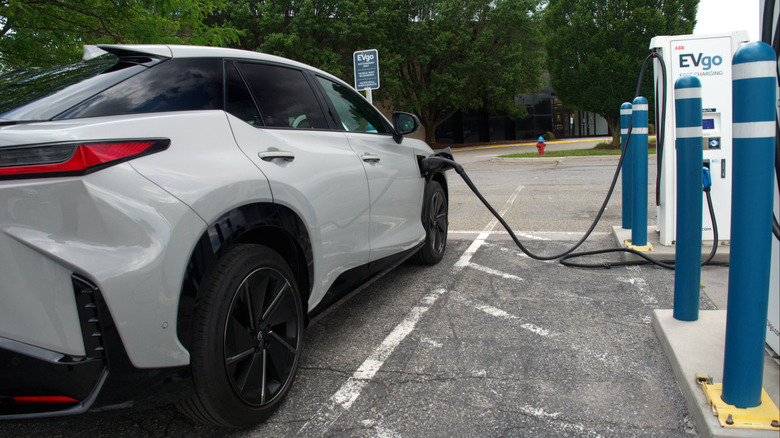
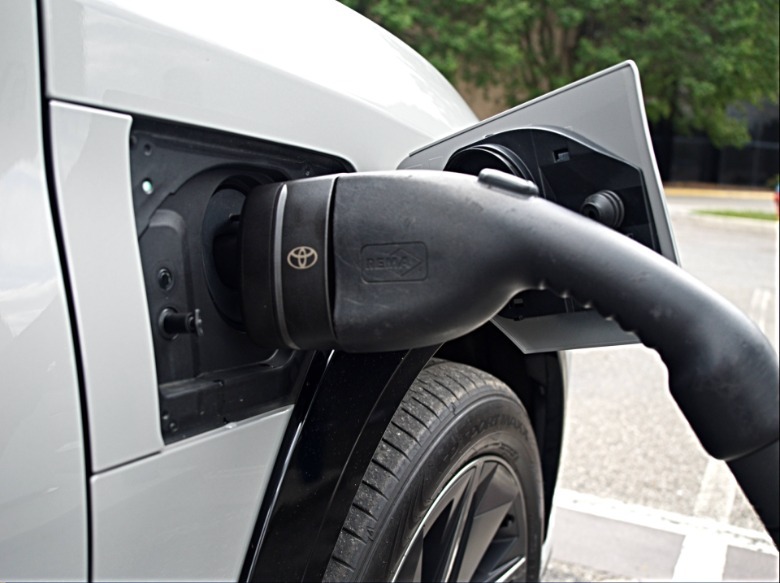
At least you can charge at any given Tesla Supercharger station now that the RZ has the NACS standard port on its right front fender, which allows you to go from 10% to 80% full in around 30 minutes.
For me, I wound up charging at my local mall’s CCS setup, which offered to pump 50 kW into the pack via the NACS-to-CCS adapter; there’s also an NACS-to-J1772 adapter for charging at work or any Level 2 charger. The estimate given by the display was an hour until 80%, or 90 minutes until full. I wound up having to restart the charging after either the RZ or the station kicked the other off (despite having up to 120 minutes of charging available). Then, I had an error on my display telling me to get the charging fixed at my nearest dealership, though that warning had disappeared by the time the Lexus had been returned.
2026 Lexus RZ verdict
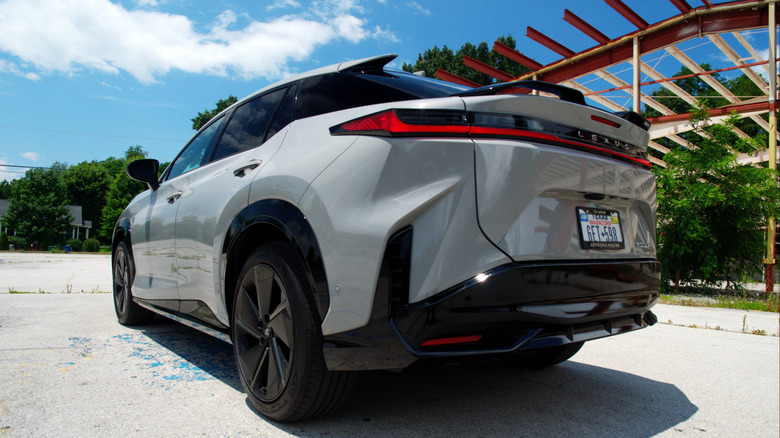
It’s only been a few years since Lexus first released the RZ. Back then, we said that while it was comfortable and refined, the real-world range left a lot to be desired. Sadly, this has not changed. Sure, we finally have one trim level good for 300+ miles on a single charge, but considering how much you’re paying for this EV — especially one with a larger battery at the top level, no less — you would have hoped things would’ve improved by now.
True, battery technology is improving all the time, with solid-state batteries promising a greater range for everything from the wildest EV sports cars to basic — and, hopefully, cheap — transportation, among other EV tech advancements. But there is so much Lexus and Toyota could do in the meantime, from better getting the environmental influences under control to devoting a second, smaller battery for the climate controls (there was a sudden and marked jump in range once I switched from Normal to Eco mode, which tamps down the HVAC’s effectiveness).
For now, however, the 2026 RZ should be considered for what it truly feels like: a second car for running errands around town and commuting to and from work on the weekdays, leaving Lexus vehicles like the LX or LC for fun weekend adventures. That’s hardly a compliment, for a luxury EV that’s priced like an all-rounder.